D.A.V. International College was established with the primary objective of creating an educational platform that caters to the growing demand for skilled profes...
Learn MoreDhobighat, Lalitpur
+977-01-5429029/ 5441144 / +977 980-1372-111
csit@davcollege.edu.np
06:30AM - 02:30PM
The Bachelor of Science in Computer Science and Information Technology (BSc CSIT) is one of the most in-demand technology degrees in Nepal, so finding the best CSIT college in Nepal is worth some real thought before you apply. It is a four-year, eight-semester science degree covering programming, systems, data, and the theory behind them, and it leads to careers in software, data, and IT. At DAV International College in Dhobighat, Lalitpur, we run BSc CSIT under Far Western University, with an emphasis on practical, hands-on work rather than theory alone.
If you are searching for the best CSIT college in Nepal, the honest answer is that no single college is best for everyone. The right one depends on what you want from the degree and how you get in. One thing that sets us apart from most colleges in the valley is that we admit through Far Western University's own entrance exam, not the Tribhuvan University IOST examination, so you have a way into the degree that does not depend on a nationwide IOST rank.
And if you have not settled on the degree itself yet, our guide to the BSc CSIT course in Nepal explains what it covers before you weigh up the colleges that offer it.
DAV International College offers BSc CSIT under Far Western University from our campus in Dhobighat, Lalitpur. It is designed for science students seeking a computing degree that leads to real technical work. You get small mentored batches, GPU-enabled computer labs, industry-experienced faculty, two supervised projects and an internship before you graduate, and admission through Far Western University's own entrance exam rather than the Tribhuvan University IOST race.
DAV International College runs its BSc CSIT in Lalitpur, within easy reach of Patan, Jawalakhel, Kumaripati, Ekantakuna, Balkumari, and Chyasal. The college is part of the DAV education group, which has run schools and colleges in Nepal for years, so the academic governance, administration, and examination systems behind the degree come from institutions with a long track record rather than something set up this year.
The program is led by Programme Head Mr. Sudip Adhikari, with Mr. Shashi Bhushan Chaturwedi as Academic Head and Mr. Anil Kedia as Chairman. The college also runs a Research and Placement Cell, whose members include PhD-qualified faculty, one of whom has a PhD in cybersecurity.
Every college in Nepal teaches the same BSc CSIT syllabus, because the university sets it, not the college. So what you are really choosing is everything around the course: who teaches you, the machines you work on, and how much real practice you get. A few things separate a college that leaves you job-ready from one that just hands you a certificate, and they are worth checking wherever you apply. Here is how DAV measures up on each:
Check the university first, because that is what makes the degree count. DAV runs its BSc CSIT under Far Western University, a government university recognised by the University Grants Commission. That means you can sit Lok Sewa exams, apply to any employer, and go abroad for a master's, the same as with a degree from any established Nepali university.
A good program does not leave every student with an identical degree. At DAV, the final year opens into electives across networking, databases, cloud, data mining, and image processing. So a student who wants to go into cloud and one who wants to go into data can take different paths and finish with a profile that fits the job they are after.
What a college makes you actually do matters, because most employers care more about what you can build than what you can recite in an exam. At DAV, the BSc CSIT includes two supervised projects and a final-year internship, plus regular lab and workshop time on the GPU machines. So by the time you finish, you have built real software and worked inside an actual company, which is what most employers look for in a fresh graduate.
In a technical subject, it helps a lot when a teacher can notice you are stuck and step in, and that only happens when classes are small. DAV keeps its batches small so students get that attention instead of sitting unnoticed in a big hall. Its Research and Placement Cell also includes PhD-qualified faculty, one of them with a PhD in cybersecurity, so there is real depth for students who want to go further.
The college worth choosing is not the cheapest or the most expensive, but the one that gives you the most back for what you pay. DAV offers merit-based scholarships that lower the cost for strong students, and the fee covers full use of the labs, library, and student support, not just tuition.
Weighed against all five, DAV is one of the better places to study BSc CSIT in Nepal, based on the things that actually shape your four years rather than on reputation.
The BSc CSIT program at DAV is built to give students a strong foundation in computing and prepare them for real technical work. Here are the main objectives of the program:
Our BSc CSIT runs over eight semesters and 137 credit hours under Far Western University. It starts with mathematics, programming, and the fundamentals of how computers work. It moves through the core of computer science in the middle years, and reaches artificial intelligence, cryptography, and web technologies in the final years, with two supervised projects and an internship. For the complete breakdown with course codes and credit hours, see our guide on Far Western University BSc CSIT syllabus, semester by semester.
| Code | Course | Cr |
|---|---|---|
| CSIT 111 | English Grammar & Composition | 3 |
| CSIT 112 | Information Technology Fundamentals | 3 |
| CSIT 113 | Calculus and Analytical Geometry | 3 |
| CSIT 114 | Electronic Principles | 3+1 |
| CSIT 115 | Programming Fundamentals & C Programming | 3 |
| Code | Course | Cr |
|---|---|---|
| CSIT 121 | Data Structure and Algorithms | 3 |
| CSIT 122 | Digital Logic Design | 3 |
| CSIT 123 | Linear Algebra | 3 |
| CSIT 124 | Mechanics and Electrodynamics | 3+1 |
| CSIT 125 | Microprocessor System | 3 |
| Code | Course | Cr |
|---|---|---|
| CSIT 211 | Computer Organization and Architecture | 3 |
| CSIT 212 | Discrete Structures | 3 |
| CSIT 213 | Introduction to Management | 3 |
| CSIT 214 | Object Oriented Programming with C++ | 3 |
| CSIT 215 | Operating System | 3 |
| CSIT 216 | Statistics and Probability | 3 |
| Code | Course | Cr |
|---|---|---|
| CSIT 221 | Applied Statistics | 3 |
| CSIT 222 | Data Communication and Network | 3 |
| CSIT 223 | Database Management System | 3 |
| CSIT 224 | Numerical Methods | 3 |
| CSIT 225 | System Analysis and Design | 3 |
| CSIT 226 | Theory of Computation | 3 |
| Code | Course | Cr |
|---|---|---|
| CSIT 311 | Design and Analysis of Algorithm | 3 |
| CSIT 312 | Artificial Intelligence | 3 |
| CSIT 313 | Compiler Design | 3 |
| CSIT 314 | Simulation and Modelling | 3 |
| CSIT 315 | Graphics and Visual Computing | 3 |
| CSIT 316 | Web Technology I | 3 |
| Code | Course | Cr |
|---|---|---|
| CSIT 321 | Introduction to Cryptography | 3 |
| CSIT 322 | Java Programming I | 3 |
| CSIT 323 | Research Methodology for Computer Science | 3 |
| CSIT 324 | Software Engineering | 3 |
| CSIT 325 | Web Technology II | 3 |
| CSIT 326 | Minor Project I | 2 |
| Code | Course | Cr |
|---|---|---|
| CSIT 411 | E-commerce | 3 |
| CSIT 412 | Advanced Java Programming | 3 |
| CSIT 413 | Object Oriented Analysis and Design | 3 |
| CSIT 414 | Minor Project II | 3 |
| CSIT 415 | Elective I, one of: Net Centric Computing, Database Administration, System Administration, Digital Image Processing | 3 |
| CSIT 416 | Elective II, one of: Data Mining and Warehousing, GIS, Management Information Systems, Neural Networks | 3 |
| Code | Course | Cr |
|---|---|---|
| CSIT 421 | Parallel Computing | 3 |
| CSIT 422 | Internship | 4 |
| CSIT 423 | Elective III, one of: Enterprise Application Development with Java, Advanced Database Design, Network Administration, Real-time Systems | 3 |
| CSIT 424 | Elective IV, one of: Mobile Application Development, Distributed Database Management Systems, Wireless Networks, Cloud Computing | 3 |
| CSIT 425 | Elective V, one of: Information Retrieval, E-Business and E-Governance, Embedded System Programming, Human Computer Interaction | 3 |
The final semester closes the degree with a compulsory internship and a set of electives, so you can finish along the track that suits you, whether that is programming, databases, networking, or algorithms.
A list of subjects only tells you what is taught. What actually matters to you, and to an employer, is what you can do at the end of the degree. Over four years, our BSc CSIT builds working ability across four areas.
The degree gives you the foundation. If you want to go further in a specific area, industry certifications taken alongside it can strengthen your profile, and we have set out which ones are worth doing in top certifications to do alongside BSc CSIT in Nepal.
DAV puts real effort into what happens outside the classroom. The college backs the degree with good facilities, active student clubs, and support that helps students move into work. Here is what students get at DAV.
The GPU section runs high-performance machines for AI, machine learning, data analysis, and heavy graphics work, which is the kind of computing the course needs from the fifth semester on. There is also the Skill-Forge lab, an industry-style space where students work on more practical, job-focused tasks.
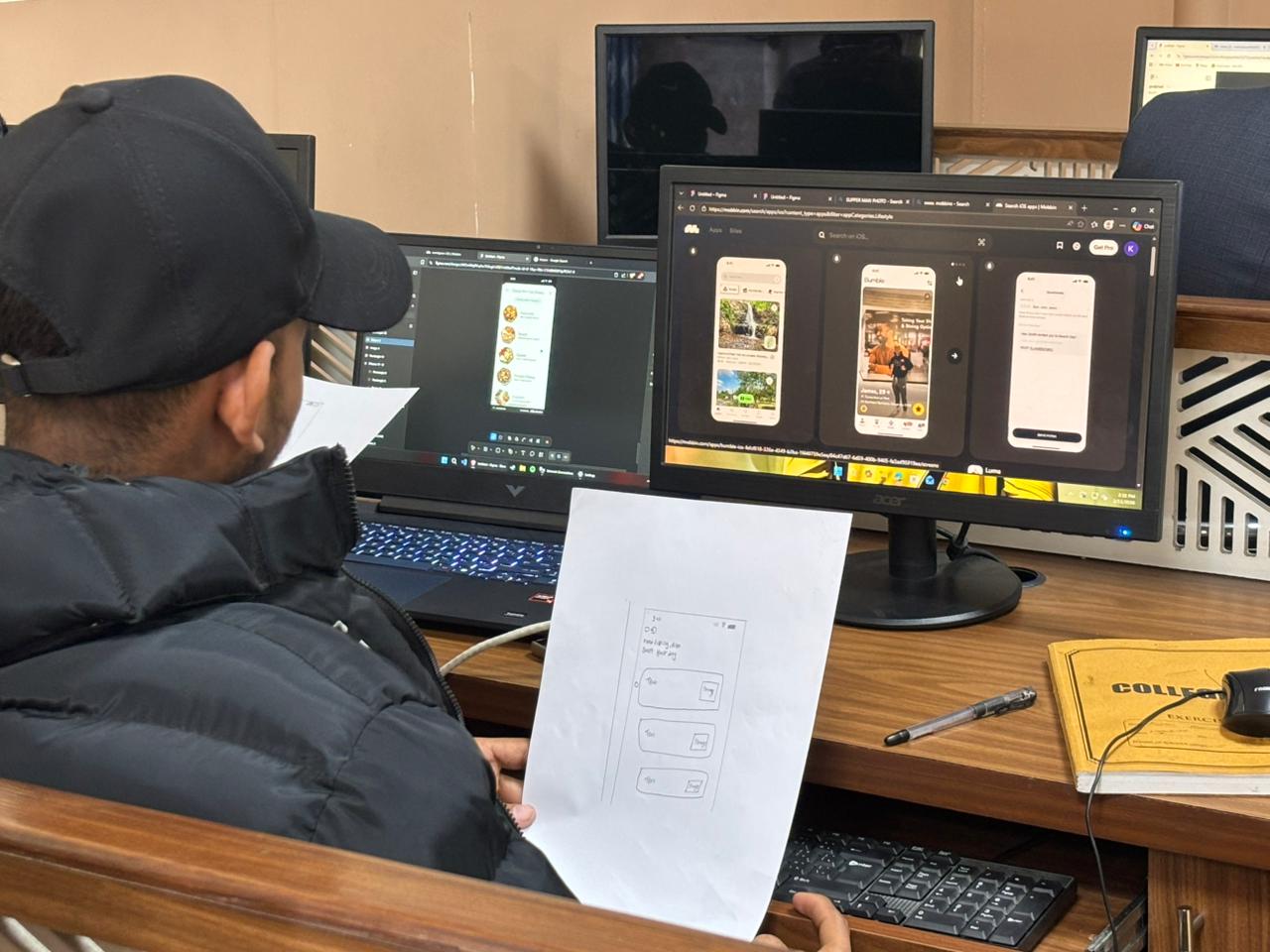
Cognito is the college's IT club, and a lot of hands-on learning happens here. It runs coding competitions, hackathons, guest lectures, and live projects, giving students a place to use what they learn and meet people already working in tech.
Whizzy Davians is the cultural and sports club. It runs the music, games, and events throughout the year and keeps campus life active outside of studies.
Getting a job takes more than technical skill. The Professional Edge Program works on communication, leadership, and interviews, and the Career Cell helps students with resumes, interview practice, and finding placements.
Students have a library, smart classrooms, and three auditoriums, Buddha, Sujata, and Jetwan halls, for talks and presentations. There is also a sports complex, a cafeteria, campus Wi-Fi, and regular yoga and meditation sessions for the busy parts of the term.
The college runs workshops beyond the syllabus in areas like full-stack and MERN development, DevOps, data science, AI, UI/UX, robotics, and mobile app development, so students can pick up current, job-ready skills alongside the degree.
We build the program around employability, and the degree opens onto a wide range of roles.
Nepal's technology sector keeps hiring computing graduates, from names like eSewa, Khalti, and F1Soft to firms building products for clients abroad. Our guide to career opportunities after BSc CSIT in Nepal explains the roles a graduate goes into, while the scope of BSc CSIT in Nepal takes the longer view of sectors and how careers progress. Landing the first job is its own challenge, so we have covered the practical steps, from building a portfolio to handling the interview, on how to get your first IT job in Nepal after BSc CSIT.
Two things are worth understanding before you commit. First, whether the degree is still worth it, which we look at, including salaries and the job market, in is BSc CSIT still worth it in 2026. Second, artificial intelligence is changing which roles grow and which shrink, and what that means for graduates is set out in AI and the IT job market for BSc CSIT graduates in Nepal.
A local job is not the only route. Many graduates earn in foreign currency through remote and freelance work for international clients, covered in freelancing after BSc CSIT, and others go on to a master's, whether an MSc in Nepal or a degree abroad, covered in life after BSc CSIT.
DAV also has a wide recruiter network to point students toward, across banking, ISPs, e-commerce, and tech, including eSewa, WorldLink, Subisu, Vianet, Ncell, and Daraz, along with most of the big Nepali banks. Being an early batch, the college leans on that network and on what it actually teaches rather than a long list of graduate names it does not have yet, and it works with students toward those employers through the Career Cell and its placement support.
This is often the first question every +2 graduate asks, and the answer is yes. Far Western University is a government university, established in 2010 by an Act of Parliament, with the Prime Minister as its Chancellor. It is recognised by the Ministry of Education and the University Grants Commission, and its BSc CSIT is a full eight-semester degree.
For you as a graduate, an FWU degree carries the same recognition as one from any other recognised Nepali university. You can sit Lok Sewa Aayog examinations for public-sector jobs, apply across the private sector, and go on to a master's at home or abroad. The real difference between Far Western University and the much larger Tribhuvan University is scale, not validity, and we have compared the two properly in Far Western University vs Tribhuvan University for BSc CSIT. And if a government job is your goal, we have set out the eligible posts and the Lok Sewa route in government jobs after BSc CSIT in Nepal.
You can join our BSc CSIT through Far Western University's own entrance, not the Tribhuvan University IOST examination. You can apply to us directly and sit our entrance exam, rather than competing for a seat on the single nationwide IOST rank. We have explained how the entrance is structured, what it tests, and how it compares with IOST in our guide to the BSc CSIT entrance exam in Nepal.
Admission dates for each intake are posted in the Notices section of our website. For the full eligibility rules, documents, and step-by-step process in one place, see our complete guide to BSc CSIT admission and eligibility at DAV International College.
DAV International College offers scholarships for BSc CSIT based on academic merit. Eligibility is assessed on your +2 results, your performance in the departmental entrance, and students who maintain strong results through the program can qualify for further grants in later semesters. Scholarship categories and current eligibility can be confirmed directly, so you can contact the admissions hotline below for further details.
The BSc CSIT fee at DAV covers tuition across all eight semesters, along with lab access, practical sessions, and student support. We keep the fee structure transparent and competitive for a Far Western University program, and scholarship support can lower the total for eligible students. Fees are reviewed periodically, so the current figure is shared directly. There are two ways to get it:
If you are still choosing between IT degrees, here is how BSc CSIT compares with the common alternatives in Nepal. The comparison most students face is with BCA, and you go through it in full in BSc CSIT vs BCA in Nepal.
| Factor | BSc CSIT | BCA | BIT | BE Computer |
|---|---|---|---|---|
| Duration | 4 years | 4 years | 4 years | 4 years |
| Entry stream | Science (+2) | Any stream | Any stream | Science (+2) |
| Academic depth | High | Moderate | Moderate | Very high |
| Maths intensity | High | Low to moderate | Moderate | Very high |
| Built for | Software, data, systems | App development | IT systems, networking | Core engineering |
BSc CSIT suits a science student who wants depth across both software and systems. If you are weighing it against the full engineering route, we have compared it with BE Computer Engineering in BSc CSIT vs BE Computer Engineering in Nepal, and against the more applied, management-oriented BIT in BSc CSIT vs BIT in Nepal.
The best CSIT college depends on what you need from the degree. If you want small batches, GPU labs, industry faculty, and real project work, DAV offers all of these under Far Western University in Dhobighat, Lalitpur. The test is to compare colleges on batch size, lab hardware, faculty, and project work, not on reputation.
Yes, if you want close faculty access and hands-on technical training rather than a large, impersonal classroom. DAV runs BSc CSIT under Far Western University in Dhobighat, Lalitpur, with small mentored batches, GPU-enabled labs, industry faculty, and the backing of the wider DAV education group.
Yes. Far Western University is a government university recognised by the Ministry of Education and the University Grants Commission. Its CSIT graduates can sit Lok Sewa examinations for public-sector jobs, work across the private sector, and go on to postgraduate study in Nepal and abroad.
No. IOST is the route into Tribhuvan University colleges. DAV is affiliated with Far Western University, which runs its own departmental entrance with a 35 percent pass mark, separate from the IOST system.
You need 12 years of science education, or the equivalent, from an institution Far Western University recognises, in second division or above with at least a C grade in each subject. Students from the biological group qualify only if they took Mathematics at +2. Admission is confirmed once you pass the departmental entrance with at least 35 percent.
BSc CSIT is a four-year degree across eight semesters under Far Western University, ending with two supervised projects and an internship in the later years.
We are at Dhobighat, Lalitpur, within easy reach of Patan, Jawalakhel, Kumaripati, Ekantakuna, Balkumari, and Chyasal.
Students learn in computer labs with GPU-enabled machines and high-speed internet, with access to digital libraries and research databases, and take part in workshops, bootcamps, and events run throughout the year.
DAV International College welcomes applications from +2 Science graduates who want a serious, career-focused BSc CSIT in the Kathmandu Valley. To ask a question or begin an application, contact the college directly.